The Thalassa Desgagnes tanker visited Sprague Energy’s terminal in the Port of Providence on March 22nd. She offloaded a cargo of flux asphalt used for roofing material.
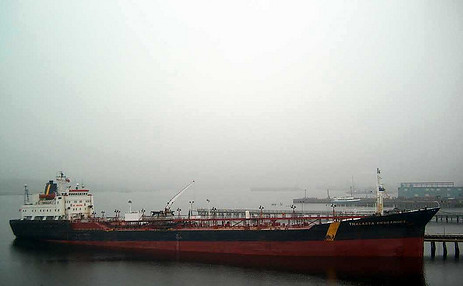
The Thalassa Desgagnes tanker visited Sprague Energy’s terminal in the Port of Providence on March 22nd. She offloaded a cargo of flux asphalt used for roofing material.
Today’s Providence Journal has an excellent editorial noting the re-emergence of commercial shipping in New Bedford due to a recent dredging project and the city’s efforts to promote marine commerce. The editorial argues that Providence should be doing the same thing rather than pushing plans for condominiums and hotels that threaten existing working waterfront businesses:
New Bedford isn’t the only recently re-dredged port in the region, but it seems to be the one most aggressively courting new business. Revitalizing ports as working ports (i.e., shipping), with their well-paid workers, is much better for the economic health of such old ports as New Bedford and Providence than blocking them off with condos and other low-paying enterprises.
The cover story in the March edition of East Side Monthly magazine is devoted to the future of the industrial working waterfront along Allens Avenue in the Port of Providence. Read the full story here.

Michael Caparco Sr.’s Jan. 24th Providence Journal letter to the editor, “City’s fine waterfront plan,” contains a number of inaccuracies and misleading statements.
First, Mr. Caparco conveniently fails to note that the City of Providence’s original plan was indeed to declare almost all of Allens Ave as “blighted and substandard,” a major step towards condemnation and eminent domain procedures. It was only after the tremendous outcry of area business and property owners that the City agreed to scale back the plan.
Second, Mr. Caparco’s letter intentionally obfuscates the difference between ProvPort, which the City is protecting with a new Working Waterfront Protection Zone, and the northern Allens Ave waterfront where the City is in fact pushing to change the current W-3 zoning to allow for hotels. The City’s waterfront plan would allow for an incompatible hotel directly in between an oil terminal, an asphalt plant, and a marine repair shipyard. No deed or lease restrictions are going to prevent future hotel guests from complaining about the truck traffic, bright lights, and noise produced by the round the clock operation of these successful heavy industrial businesses.
Finally, contrary to Mr. Capraco’s claim, there are no “abandoned” lots on Allens Ave. The once vacant property at 434 Allens Avenue is now being used by Rhode Island Recycled Metals to scrap the Russian submarine. Next door at the Shepherd’s warehouse site, Cumberland Farms employs 38 people and the company is exploring a number of options to revitalize the property. Far from “abandoned,” businesses along the approximately one mile stretch of Allens Avenue north of Thurbers employ more than 800 people and generate approximately $1.5 million in annual property and excise taxes for the City.
There is one statement with which we agree with Mr. Caparco, that “there is simply too much potential along the city’s waterfront for any of us to be misled into accepting an unacceptable status quo.” That’s why the City should abandon its vision of incompatible hotel uses on Allens Avenue and instead promote marine industrial expansion and good blue collar jobs, just as they are rightly pursuing at ProvPort.
Today’s Providence Journal has an excellent op-ed from Senator William Walaska and Rep. Peter Kilmartin, the co-chairs of the General Assembly’s port development study commission, on the critical need to protect Rhode Island’s limited port area lands for future marine industrial growth.
Economic development often requires a series of active steps to put Rhode Island in the position to take best advantage of its resources. As co-chairmen of the Special Legislative Commission to Study Potential Economic Opportunities in the Development of Port Facilities in the State of Rhode Island, we are deeply committed to supporting and expanding port and port-related activities within Rhode Island’s commercial and industrial waterfront zones.
At the hearings of the Legislative Port Commission and during tours of port facilities across the state, the commission members were very supportive of not only maintaining existing port activities but also identifying ways to expand and provide new opportunities for water-dependent businesses to relocate to our waterfront.
Recently, the City of Providence released its Waterfront Plan. We had communicated our concerns with prior drafts of this plan to Mayor Cicilline. Now more than ever, the city’s planning and redevelopment projects are vital to the health and welfare of the entire state.
The Providence Working Waterfront Alliance applauds the leadership of Sen. William Walaska and Rep. Peter Kilmartin on this critical issue. Unfortunately, the City of Providence’s Waterfront Plan still calls for changing the zoning along Allens Avenue’s working waterfront to allow for incompatible hotel uses. Indeed, the plan would allow for an incompatible hotel directly in-between an oil terminal (Sprague Energy), an asphalt plant (Narragansett Improvement), and a marine repair shipyard (Promet Marine). No deed or lease restrictions will prevent future hotel guests from complaining about the truck traffic, bright lights, and noise produced by the round the clock operation of these successful heavy industrial businesses.
We look forward to continuing to work with leaders in the General Assembly and the Providence City Council to protect Allens Avenue’s working waterfront for future marine industrial growth.
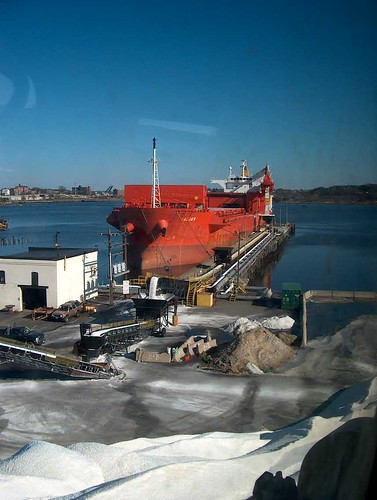
The carrier the Balder recently visited Sprague Energy’s Allens Avenue terminal to offload 40,000 tons of road salt. That’s enough road salt to supply approximately 1,500 trucks.
On Tuesday, December 15th at 4:45pm the Providence City Plan Commission will take public testimony on the city’s Waterfront Plan and the Allens Avenue & Port Redevelopment Plan.
Please come and voice your opposition to the city’s attempt to declare 590 acres of port area land as “blighted and substandard,” and therefore subject to condemnation and eminent domain procedures. Also voice your opposition to the city’s plan to allow for incompatible hotel uses to be located directly adjacent to Allens Avenue’s working waterfront and heavy industrial businesses.
These plans threaten good paying blue collar jobs and future marine industrial growth in the Port of Providence.
What: Providence City Plan Commission public hearing
When: Tuesday, December 15th at 4:45pm
Where: Providence Public Safety Complex (325 Washington Street, Providence)
Thank you for your continued support.
Providence Working Waterfront Alliance
www.providenceworkingwaterfront.org
 Thank you to State Senator Harold Metts, whose district includes most of the Port of Providence, for opposing the radical Allens Avenue & Port Redevelopment Plan that would declare 590 acres of land as “blighted and substandard.” The Providence Working Waterfront Alliance agrees that this plan threatens good paying blue collar jobs.
Metts not convinced Allens Avenue plan has merit
STATE HOUSE – Sen. Harold M. Metts (D-Dist. 6, Providence), in a letter to Providence Mayor David Cicilline, said he cannot support the announced waterfront redevelopment plan along Allens Avenue.
Senator Metts said his primary concerns about the proposed plan are how it will affect those living in the nearby low-income neighborhoods he represents, how it will impact on jobs that exist in the area and on the creation of good new jobs and why, since support for the plan at the state level is a key variable, he and his legislative colleagues from the Southside and Washington Park areas were not informed of the plan before it was unveiled.
“Until I am presented with some compelling evidence to the contrary,” said Senator Metts in his letter to the mayor, he is concerned the proposal will threaten companies that employ thousands of people and put hundreds of millions of dollars into the economy.
As outlined by the city’s Redevelopment Agency, the plan calls for Providence to declare 590 acres along the Allens Avenue waterfront as blighted and substandard, thereby giving the agency the power to take properties by eminent domain and steer redevelopment in an area that is largely composed of contaminated areas and vacant, abandoned and underused properties.
The Redevelopment Agency plan is part of the vision to transform ProvPort and, through new development, encourage new investment on Allens Avenue and make the waterfront a more public destination.
“We need high paying blue collar jobs, not the low paying service sector jobs proposed by developers,” said Senator Metts in his letter to Mayor Cicilline.
Senator Metts said he is also troubled by concerns raised by the U.S. Department of Energy that the waterfront plan may have negative consequences for the petroleum fuel supply in New England since a number of major fuel terminals are located along the waterfront. He said he is also worried that declaring the area “blighted and substandard” will “open the door to unjust seizure” of properties in the area.
“The bottom line for me on any proposed plan is how it will benefit the people in Senate District 6, the City of Providence and the State of Rhode Island,” said Senator Metts in his letter to the mayor. The plan as outlined, he said, appears to offer benefits only for developers and does not address the concerns or fears raised by area residents or businesses.
emphasis added
Statement of the Providence Working Waterfront Alliance
On the Waterfront Plan and the Allens Avenue & Port Redevelopment Plan
December 1, 2009
Overview
For the past two years, the Providence Working Waterfront Alliance (PWWA) has worked diligently to educate Providence city officials and the public about the critical role of water-dependent and inldustrial businesses located along Allens Avenue’s historic working waterfront. Collectively, these businesses generate hundreds of millions of dollars in total economic impact, supply critical regional energy resources, provide hundreds of good paying blue collar jobs, and thousands more related jobs. In short, the Allens Avenue area in the Port of Providence is a vital regional economic resource that must be protected from incompatible residential uses that threaten existing marine and industrial businesses, and future port growth opportunities.
While a great deal of progress has been made since the release of earlier city planning documents (Narragansett Landing Plan, Providence 2020, early drafts of the Interim Comprehensive Plan) which did not depict any water-dependent or industrial businesses on Allens Avenue, the Providence Planning Department’s Waterfront Plan continues to cling to a discredited vision of mixed-use residential and hotel uses directly next to heavy marine industrial businesses.
This mixed-use vision, at the heart of the Waterfront Plan, runs directly counter to the overwhelming consensus reached at the June 2008 Waterfront Charrette where invited experts, area businesses, and the public agreed that residential uses are incompatible with existing Allens Avenue working waterfront and heavy industrial businesses. As the Providence Journal’s June 13, 2008 headline read, “Housing on city waterfront rejected at charrette.”
Unfortunately, this clear consensus is not reflected in the current Waterfront Plan. PWWA members remain united in opposition to any mixed-use zoning that would allow for incompatible residential or hotel uses to be sited directly next to existing heavy marine and industrial operations. In addition, none of the “buffering” strategies outlined in the Waterfront Plan give any area businesses the confidence that they will not be complained out of business by future residents and/or hotel guests. There is ample evidence from Providence and port communities around the country that residents will complain about nearby industrial operations, that these complaints inevitably lead to operating restrictions, which in turn threaten the viability of industrial businesses. This point is explicitly made in a November 10, 2009 U.S. Department of Energy letter to Governor Carcieri and Mayor Cicilline which notes serious concerns with the mixed-use vision outlined in the Waterfront Plan:
“A mixed use commercial district would allow the building of hotels, marinas, and condominiums immediately adjacent to existing oil terminals. This could have a negative impact on the commercial operations of those fuel terminals. Rezoning may result in future restrictions on terminal operations to accommodate residential preferences that could endanger the economic viability of terminals given the differing nature of the established and proposed uses of the areas in question. This could eventually result in the loss of petroleum storage capacity for the region.”
Put simply, residential condominiums, hotels, and marinas do not belong in this historically industrial working waterfront area. Indeed, the Allens Avenue industrial corridor has been successful precisely because it is already well buffered from residential neighborhoods by I- 95 to the west, and the hurricane barrier and I-195 interchanges to the north. The introduction of residential uses on Allens Avenue is a recipe for conflict and the slow death by a thousand cuts of the area’s water-dependent and heavy industrial businesses.
It is also impossible to comment on the Waterfront Plan outside of the context of the vastly overbroad Allens Avenue & Port Redevelopment Plan ordinance introduced before the Providence City Council on November 5th. This plan would declare all properties along Allens Avenue and in the ProvPort and Harborside areas as “blighted and substandard,” thus enabling the Providence Redevelopment Agency (PRA) to use its broad powers of condemnation and eminent domain. The plan would be in effect for 40 years, and at any point during this time period the PRA could begin condemnation / eminent domain procedures against any properties within the approximately 590 acre redevelopment plan area.
Even the mere threat of eminent domain over the next 40 years will serve as a disincentive for area businesses to invest in their properties, expand operations, and grow jobs. This redevelopment plan grants the PRA wide flexibility to “redevelop” the area, yet offers absolutely no assurances to existing businesses and property owners. This radical plan is completely unacceptable to the members of the PWWA and other Allens Avenue area businesses who demand to be removed from the redevelopment plan area.
If the city and the PRA’s true goal with this plan is solely to aid the expansion of ProvPort onto adjacent properties, then the redevelopment plan should be rewritten and the map redrawn to narrowly focus on ProvPort and these specific projects.
For the reasons stated broadly above, and in detail below, the PWWA opposes, in their current form, the Waterfront Plan and the Allens Avenue & Port Redevelopment Plan ordinance.
Instead, the PWWA urge the adoption of the planning and zoning principles outlined in the September 2008 Horsley Witten Group study of the Allens Avenue Corridor. This study recommends the adoption of “mixed-use industrial” zoning that would prohibit incompatible residential and hotel uses while maintaining the flexibility to allow for lower intensity non-residential uses such as commercial office buildings.
The PWWA feels this is a reasonable compromise that will provide needed protections for Allens Avenue’s industrial businesses, while providing the city with the flexibility to attract compatible new uses to the area.
Detailed Responses to the Waterfront Plan
Waterfront Plan:
Page 1, first paragraph, first sentence: “Providence Tomorrow: The interim Comprehensive Plan was approved by the State of Rhode Island in July, 2008.”
Response:
The interim Comprehensive Plan was approved by the State of Rhode Island in July 2008 along with important comments and recommendations relative to Providence’s waterfront. As stated in the July 15, 2008 letter from the Department of Administration to Mr. Thomas Deller:
“Although the Future Land Use Map (FLUM) on page 100 in the Comprehensive Plan shows the actual ‘Port of Providence’ as being an area limited to the southern part of Allens Avenue (south of Thurbers Ave), the State designation stretches further north along the waterfront into the areas designated as ‘Waterfront Mixed-Use’ on the FLUM. Strategy LU.3.r of the State Guide Plan Element 611 states ‘Reserve waterfront land at the State’s ports to meet future shipping and passenger transportation needs.’ This discrepancy in definition of the ‘Port’ may create some confusion as it is currently labeled in the Plan. A more detailed description of the labeling of the Port in the FLUM will may alleviate potential confusion.”
“Though the Plan does allow for residential uses in the Waterfront Mixed Use areas, it does set a priority for industrial uses in those areas. The city may consider designating this area as a Waterfront Jobs District, intended for industrial, manufacturing, commercial and offices uses to support water freight and transportation job growth and expansion with no residential uses permitted. This use would serve as a transition between heavier port uses and other areas (Downtown/Jewelry District to the north and residential to the west). The ongoing ‘Charrette’ process may result in some valuable feedback regarding the future of this important area of the City.”
Unfortunately, the Waterfront Plan does not adequately incorporate these recommendations.
First, throughout, the Waterfront Plan tries to conflate the city owned land at ProvPort as if it were the entire Port of Providence. As the comment above notes, this is incorrect. The State Guide Plan and the Coastal Resources Management Council define the Port of Providence as inclusive of ProvPort, Motiva, and the Allens Avenue waterfront along the entire 40ft federally dredged channel. The area also includes critical oil terminals (Capital Terminal and Exxon Mobile) on the East Providence side of the port. The Port of Providence is an interrelated whole that the State Guide Plan rightly states should be reserved to meet “future shipping and transportation needs,” not the construction of condominiums or hotels which do not need direct access to deep water.
Similarly, the Waterfront Plan entirely ignores the second recommendation made by the State, that the northern Allens Avenue area be reserved as a Waterfront Jobs District that prohibits residential uses and serves as a transitional area between heavy port uses and residential areas to the north and west. The PWWA strongly urges that the Waterfront Plan be revised to incorporate these very sensible recommendations, which are similar to those made in the Horsley Witten Group’s September 2008 planning and zoning study of the area.
Waterfront Plan:
Page 1, second paragraph:
Providence Tomorrow is the most recent of several plans that address the Providence Waterfront, beginning in 1990 with the Industrial Waterfront Plan. That plan was the result of a study conducted in the late 1980s that concluded that the industrial waterfront is an important part of the regional economy and that future land uses should contribute to the further growth of existing industries and utilities. As a result of the study, the waterfront was zoned for waterfront industrial uses.
Response:
The 1990 Industrial Waterfront Plan and the resulting W-3 Port/Maritime Industrial zoning have been a tremendous success. They have helped the entire Port of Providence become one of the top 50 ports in the nation and attracted $63 million in state and federal funds to dredge the channel to 40ft, which in turn has leveraged millions more in dredging and capital improvements at several port terminals (Sprague Energy, Promet Marine, Motiva, St. Lawrence Cement, and ProvPort).
Waterfront Plan:
Page 1, second paragraph:
In 1999, the Narragansett Landing study had a very different vision. That plan outlined an ambitious vision for a new 250-acre waterfront development that would replace industrial uses with marinas, apartments, office buildings and parks. Though the plan was never officially adopted by the City, nor any regulations amended to make way for the new development, a clear signal was sent by the City that this new vision for the waterfront was being considered. Providence 2020 was issued in 2005, envisioning an expanded downtown that included the waterfront area south to Thurbers Avenue, and was intended to direct and shape private investment for a variety of economic activities, including innovative industries, research, commercial and retail activities, and cultural uses. (emphasis added)
Response:
Sadly, these are the very plans that have cast a cloud over industrial growth on Allens Avenue for the last decade. The Narragansett Landing study’s “vision” for Allens Avenue didn’t include a single smokestack or marine industrial business. Indeed, a 2003 Narragansett Landing Implementation Study recommended that both sides of northern Allens Avenue “come under public control by designating all of Narragansett Landing from Collier Point Park to Thurbers Avenue for condemnation pursuant to a redevelopment plan.”
Similarly, the 2005 Sasaki Providence 2020 study contained lavish drawings of a recreational Allens Avenue waterfront filled with condominiums and marinas, but without a single existing industrial business depicted.
The “clear signal” that has been sent by the city through these plans is that water dependent and industrial businesses are not wanted on Allens Avenue. Unfortunately, this message continues to be delivered through the current Waterfront Plan’s insistence on introducing residential uses on Allens Avenue. This “clear signal” is sent even more directly by the Allens Avenue & Port Redevelopment Plan’s call to designate the entire port area as “blighted and substandard,” and subject to condemnation / eminent domain by the PRA.
Simply repeating the same failed plans over and over again, does not somehow make them more viable or correct. Despite the cloud created by these plans, Allens Avenue’s water-dependent and industrial businesses are thriving. According to the June 2008 economic impact report conducted by FXM Associates, just 7 water-dependent, water-enhanced, and industrial businesses in the Allens Avenue area are responsible for:
Rather than pushing forward with yet another plan that threatens existing Allens Avenue industries with uncertainty, the city should work with area businesses to grow jobs and attract new industrial users. The city has it right to be promoting such industrial development at ProvPort, but it should extend the exact same logic to the entire Allens Avenue working waterfront / industrial area.
Waterfront Plan:
Page 1, third paragraph:
One of the key points made during the waterfront charrette and reinforced by public input received throughout the process was that the city’s unique marine infrastructure needs to be protected and that water dependent businesses need assurances that they will be permitted to continue to operate in place and, where possible, be able to invest in expanding their operations. We have heard those concerns loud and clear. To that end, the City has worked extensively with ProvPort and proposes a series of actions, detailed in this plan, to expand its operations and bring additional jobs to Providence residents.
Response:
Water-dependent and industrial businesses along all of Allens Avenue, not just at ProvPort, need assurances that they will be permitted to exist and expand their operations to create jobs for Providence residents. The current Waterfront Plan contains insufficient assurances that northern Allens Avenue industrial businesses will not be threatened by incompatible residential mixed-use development.
Waterfront Plan:
Page 4:
The study area contains three distinct areas: the area south of the hurricane barrier along the relocated I-195 in Fox Point, the Port of Providence and the waterfront area that connects the two, along Allens Avenue.
Response:
Once again, the State Guide Plan and the Coastal Resources Management Council treat the Port of Providence as an integrated whole. Also, the 40ft federal channel runs the entire length of Allens Avenue all the way up to Sprague Energy’s terminal.
Waterfront Plan:
Page 8, first paragraph:
The industrial area south of Thurbers Avenue is the ideal location for water-dependent heavy industry. Sited on a newly dredged deep water channel with direct on-dock rail access and convenient highway access, this area has the marine infrastructure in place to support water-dependent uses.
Response:
This is not the only area ideally situated for water-dependent heavy industry. Both Sprague and Promet sit directly off of the newly dredged 40ft deep water channel and benefit from convenient highway access. In addition, Sprague Energy has had conversations with the Providence & Worcester Rail Road about the potential use of the rail spur on northern Allens Avenue.
Similarly, Rhode Island Recycled Metals chose their 434 Allens Avenue location because of its access to the channel and direct rail and highway access.
Waterfront Plan:
Page 8, first paragraph:
ProvPort, with overall management and stevedoring services provided by Waterson Terminal Services, occupies a large portion of the land in this area, with over 100 acres dedicated to port activities. The Port has six berths, which total approximately 3,500 linear feet. This infrastructure enables them to offload over 2,000 ships annually, handling over 2.5 million tons of primarily bulk cargo such as coal, cement, chemicals, salt and aggregates, and break bulk cargo such as steel, copper and forestry products. (emphasis added)
Response/Correction:
ProvPort alone does not handle 2,000 ships annually. The entire Port of Providence, encompassing all area terminals (Sprague Energy, Motiva, ProvPort, Capital Terminal, and Exxon Mobile) handles more than 2,000 ships annually.
Waterfront Plan:
Pages 16-17: Additional Constraints for Water-Dependent Development section
Response:
This section aims to portray marine industrial expansion along northern Allens Avenue as being extremely difficult and/or prohibitively expensive. Not being marine engineers however, Ninigret Partners and the Planning Department greatly underestimate the innovative marine infrastructure techniques that can be employed. For example, floating, temporary, and spud barges can be used to “pier out” over shallow water to reach the 40ft channel.
This is exactly the technique being used by Rhode Island Recycled Metals. Their spud and temporary barge setup has been approved by the Coastal Resources Management Council. Rhode Island Recycled Metals also intends to apply for bulkheading permits and to eventually dredge to 20-25ft to accommodate barge service.
Similarly, a short sea shipping operator recently toured Allens Avenue and found both 434 Allens Avenue and 200 Allens Avenue (Providence Piers) to be promising sites for a proposed barge to rail operation.
Finally, marine infrastructure investments can be costly. That’s precisely why the city has applied for $39 million in stimulus funds for projects at ProvPort. Rather than actively dissuade similar projects/investments on northern Allens Avenue, the city should work with area businesses to apply for federal and state infrastructure funds that will help expand operations and grow jobs.
Waterfront Plan:
Page 18, first paragraph:
Several uses that should be protected and promoted are not currently permitted in the W-3 zone, while other uses are permitted that should be excluded. For example, the W-3 zone does not allow ship and boat building and repair while restaurants are permitted. Retail and commercial uses are permitted in the W-3, if they are related to a water-dependent business. In addition, through “residential mixed use,” a residential development could be built as long as it is combined with a permitted commercial use. Therefore, a store that sells marine supplies could have apartments or condominiums on upper floors by right.
Response:
The PWWA agrees that certain historical errors, such as the ship and boat building and repair (which is explicitly permitted in the M2 zone right across Allens Avenue) should be corrected to broaden the uses allowed. Likewise the “residential mixed use” is an anachronism left over from the days of caretakers living on-site, and now should be flatly prohibited in the entire area. The PWWA also notes that the footnotes for the entire Zoning Ordinance were jumbled and printed incorrectly for several years. All footnotes should be renumbered consecutively throughout the Use Table. Finally, as to restaurants, the PWWA does not oppose them outright, since they are a useful ancillary use to the industrial and maritime uses, serving the workers in the area. However, they should be subject to appropriate restrictions, including a special use permit, to prevent them from coming into conflict with their industrial neighbors.
Waterfront Plan:
Page 18: Port Commission section
Response:
The PWWA applauds the recreation of the Port Commission as an entity to promote commerce in the port area. The PWWA strongly urges that a representative from a water-dependent or industrial business in the northern Allens Avenue area be appointed to serve on the commission.
Waterfront Plan:
Page 19, second paragraph:
Demand for the I-195 parcels for housing may increase as the area becomes more attractive as a result of development of the Jewelry District, expansion of hospitals and universities, and construction of the new waterfront parks.
Response:
The I-195 parcels inside of the hurricane barrier and along both sides of the city’s river walk are the ideal place to build a mixed-use residential neighborhood. Unlike on Allens Avenue, mixed-use development in this area would not threaten industrial businesses. This is where Providence should develop its “Inner Harbor,” while protecting and reserving its port area along Allens Avenue for marine industrial growth.
This is precisely what Baltimore has done. They have promoted mixed use development in their Inner Harbor and protected their industrial port lands, which run along the port’s deep water channel, using a Maritime Industrial Zoning Overlay District (MIZOD) which prohibits residential and hotel uses.
Waterfront Plan:
Page 20, fifth paragraph:
Short sea shipping requires substantial landside area, which would necessitate parcel consolidation as well as infrastructure improvements.
Response:
A short sea shipping operator has toured Allens Avenue and found both 434 Allens Avenue and 200 Allens Avenue (Providence Piers) to be promising sites for a proposed barge to rail operation.
Waterfront Plan:
Page 20, sixth paragraph:
Energy distribution and storage on the Providence waterfront is primarily petroleum-based. The City receives 10% of the total petroleum products delivered in New England. Most of this is gasoline. Gasoline demand may decrease as fuel cell technologies are developed. Additionally, continued decline in the use of home heating oil is expected, as natural gas is likely to become the primary source of fossil fuel heat in Rhode Island. While demands are changing, it is unclear what implications there will be on fuel oil storage facilities. Providence may continue to be an energy distribution site with or without petroleum-based products due to its location, water and rail access, infrastructure, and regulatory clearance.
Response:
In a November 10th letter to Governor Carcieri and Mayor Cicilline, the U.S. Department of Energy clearly states the critical importance of the port’s oil terminals to the supply of gasoline and home heating oil to the region:
“Providence serves as an important gateway for the import of petroleum products into the state and region. Statistics from the DOE’s Energy Information Administration indicate that almost all of the transportation and heating fuel products consumed in Rhode Island, eastern Connecticut, and parts of Massachusetts are supplied via marine shipments through Providence. For example, in 2008, over 35 percent of the petroleum distillates sold in Rhode Island entered the state through the Port of Providence. Even more significantly, over one and one-half times the amount of all of the gasoline sold in Rhode Island was received through the Port for distribution within the state and neighboring states. For this reason, the Sprague Energy and Motiva terminals in the Allens Avenue Industrial Corridor are essential not only to Rhode Island, but also to the Northeast.”
The Port of Providence will remain a key source of regional fuel energy for the foreseeable future. In addition, new state and federal requirements for blended biofuels will likely require additional tank storage capacity.
Waterfront Plan:
Page 23:
First, any significant investment would likely require site assembly and preparation. The area, particularly Allens Avenue, is characterized by a large number of small parcels that do not contain adequate land area to support many of the desired uses.
Response:
“Site assembly and preparation” is code for using the Allens Avenue & Port Redevelopment Plan ordinance to take Allens Avenue parcels via condemnation or eminent domain. This is unacceptable to the PWWA and other Allens Avenue business owners who should have the right to determine “the desired uses” of their properties.
Waterfront Plan:
Page 25, second paragraph:
RIPTA is currently proposing a street car loop through the Jewelry District and Downtown. It is envisioned that the loop could add extension lines – Allens Avenue is identified as one option, extending south from the Jewelry District.
Response:
Any street car or light rail on Allens Avenue could interfere with the Providence & Worcester Railroad’s right of way along the avenue. The railroad has not abandoned this line and has had conversations with Sprague Energy and Rhode Island Recycled Metals about reactivating the line for freight traffic.
Waterfront Plan:
Page 28, A Working Waterfront section:
Response:
The PWWA generally supports the goals of the “A Working Waterfront” section. However, the suggested improvements and protections for water-dependent businesses should not only apply at ProvPort. Infrastructure investments and the “creation of a new zoning district to serve as an exclusive heavy marine industry zone” should also apply to heavy industrial water-dependent uses in the northern Allens Avenue corridor. These should include the operations at Sprague Energy, Promet Marine, and Rhode Island Recycled Metals.
The PWWA completely disagrees that the Allens Avenue & Port Redevelopment Plan, as it is currently written, will help achieve the goals of “A Working Waterfront” in the northern Allens Avenue area. Instead, this vastly overbroad plan will threaten existing businesses and future industrial growth opportunities.
Waterfront Plan:
Page 30, third paragraph:
As the continuing evolution of the waterfront unfolds, water-dependent activities should be interspersed with other compatible land uses to enhance public enjoyment of the Bay and exposure to the working waterfront. New mixed-use activity hubs should emerge along the waterfront, weaving together and reflecting Providence’s diverse cultures, the interests of businesses and mariners, employees and residents, recreation enthusiasts and others seeking enjoyment of the waterfront. Providence should encourage and foster a balance of uses and activities on the waterfront. An array of new open space, recreation, maritime and commercial activities, all of which should be accommodated, will reunite the City with its waterfront by providing new gathering places that are full of life and activity.
Response:
This section represents a fundamental misunderstanding of the term mixed-use. Mixed-use does not mean siting incompatible residential and hotel uses directly next to heavy industrial businesses. This point was made over and over again at the waterfront charrette by experts from Boston, Portland, Maine, and Baltimore.
In Boston, Vivien Li of the Boston Harbor Association described how waterfront condo owners and tenants have complained about truck traffic in the port area. She also noted that deed restrictions are unenforceable, as residents with enough money to rent/own waterfront property also have the resources to hire attorneys to file nuisance complaints and to lobby local legislators to pass operating restrictions.
In Portland, Maine, Planner Bill Needelman described how allowing the development of residential condominiums directly next to active fishing piers in the 1980s was a mistake. As a result, the city actually passed more restrictive zoning to prevent such incompatible uses. While Portland is again reviewing its inner harbor waterfront area zoning regulations due to the sharp decline in the local fishing industry, the city maintains restrictive industrial zoning policies for the port’s heavy industrial users, including Sprague Energy which operates a cargo facility there.
In Baltimore, Planner Douglas McCoach described the vibrancy of the city’s mixed-use inner harbor which no longer contains industrial uses. However, he also described Baltimore’s large marine industrial outer harbor area which is protected by an extremely restrictive Maritime Industrial Zoning Overlay District (MIZOD) which prohibits residences, hotels, and other incompatible uses. This largely uninterrupted MIZOD protection area generally follows land frontage adjacent to the Port of Baltimore’s deep water channel. In May 2009, Baltimore Mayor Sheila Dixon signed legislation extending MIZOD protections through 2024.
The PWWA opposes the Waterfront Plan’s insistence on allowing incompatible residential/hotel mixed-uses directly next to Allens Avenue’s water-dependent and heavy industrial businesses. Providence’s “Inner Harbor” from the hurricane barrier north, along the river walk area, is the best place to promote this type of development.
The PWWA also supports public access to the waterfront where appropriate. India Point Park and Collier Park are ideal public waterfront access points that do not interfere with heavy port operations.
Waterfront Plan:
Page 30, Access to and Along the Waterfront section
Response:
The PWWA generally supports the goals outlined in this section. The public should enjoy access to Narragansett Bay in areas that do not present safety or homeland security concerns. Again, India Point Park and Collier Park are ideal locations for such access.
The PWWA disagrees with the goal of “encouraging new recreational boat moorings,” especially in CRMC Type 6 waters which are reserved for heavy marine traffic. This will pose a safety hazard for both recreational boaters and the large ocean going vessels which frequent the port. Similarly, recreational boat moorings should not be allowed within the port’s turning basin, where the prop wash from tugs turning around large ships could easily overturn recreational boats.
Waterfront Plan:
Page 33, Economic Access Reflecting the Diversity of Providence section
Response:
The PWWA strongly supports efforts to grow waterfront job opportunities for city residents. We look forward to working with city officials to explore options like marine trade apprenticeships that can give Providence residents the skills needed to work in the port.
Marine repair contractor J. Goodison Company, which operates at Promet’s pier, is an excellent example of this. To maintain their federal HUB Zone contractor certification, J. Goodison is required to hire and train low income area residents. Employees gain the skills needed to earn a living wage, and J. Goodison is able to attract U.S. Coast Guard and other federal marine repair contracts.
Waterfront Plan:
Page 37, first paragraph:
The Waterfront Study and Charrette focused primarily on the small stretch of land linking the Port of Providence to downtown along the Allens Avenue Corridor. Approximately 1 mile long, this area has been in transition for decades. The parcels in the study area have several special attributes and qualities that are unique, however, while there are two water-dependent businesses flourishing in this area, much of the land along the water’s edge remains vacant or underutilized. To the west of Allens Avenue, a few active manufacturing are thriving amidst a mix of other uses.
Response:
Once again, the Port of Providence is not just ProvPort. It is the entire port area, and particularly the terminals and properties located off of the federal channel.
It is inaccurate to describe the Allens Avenue Corridor as “in transition for decades” as several area businesses have thrived in the area, including Sprague Energy and Narragansett Improvement who have been in continuous operation for over 100 years. Rather, industrial growth in the area has been under a decade long cloud precisely because of the many mixed-use residential redevelopment plans the city has pushed. Sadly, the current Waterfront Plan’s insistence on incompatible mixed-uses will continue to discourage port industrial growth along Allens Avenue.
The Waterfront Plan should also be updated to reflect the fact that a formerly vacant Allens Avenue site is again being used for a water-dependent industrial use. Rhode Island Recycled Metals has begun operations at 434 Allens Avenue, where they intend to scrap the Russian submarine and conduct other scrap projects. They are also planning a number of site improvements including bulkheading, dredging, and the reactivation of on-site rail to allow for scrap export by barge and rail.
Finally, while the PWWA agrees that some underutilized parcels do exist in the area, it is important to note that Allens Avenue Corridor businesses collectively pay $1.4 million in annual property taxes and approximately $100,000 in annual excise taxes. This is in contrast to the nonprofit ProvPort, which pays no property taxes on over 100 acres of land valued at more than $40 million.
Waterfront Plan:
Page 37, second paragraph:
The waterfront study and charrette made clear that the waterfront in this area is a critical asset to the city for the ongoing viability of the existing water-dependent businesses, and for public use and access to the waterfront. There was a consensus that a mix of uses could be accommodated in this area as long as mechanisms were put in place to ensure compatibility of industrial and non-industrial uses.
Response:
No such consensus was reached at the waterfront charrette. In fact, the exact opposite conclusion was reached by the overwhelming majority of invited experts, area business owners, and Providence residents who voiced opposition to allowing residential uses on Allens Avenue.
Waterfront Plan:
Pages 37-38, Use and Design Considerations section
Response:
The PWWA strongly opposes the Waterfront Plan’s continued insistence on allowing incompatible residential and hotel uses directly next to the area’s heavy industrial businesses. The plan should instead reflect the overwhelming sentiment voiced at the waterfront charrette, and prohibit these uses.
The Waterfront Plan notes “The type of housing envisioned for the area is rental workforce housing for employees of businesses in the area.” Nowhere in the Ninigret Partners study is workforce housing ever mentioned as a viable option. In fact, for residential uses, the study concludes that “Entry prices will need to be at least $425,000 and likely over $600,000 given site assembly, remediation costs and construction expenses.” (page 17) Putting aside the fundamental incompatibility with nearby industrial businesses, rental workforce housing would not be financially viable.
The “buffering” techniques described in this section are also wholly inadequate. Vertical and visual buffers will not accomplish the separation that is needed to prevent existing industrial businesses from being complained out of business by future residents or overnight hotel guests.
These weak buffering recommendations are particularly inadequate for any residential or hotel use at 200 Allens Avenue which sits directly in between Sprague Energy’s oil terminal, Narragansett Improvement’s asphalt plant, and Promet Marine’s shipyard. These long established industrial businesses produce loud noises, heavy truck traffic, and bright lights. They also frequently operate during late night and early morning hours. Allowing a residential or hotel project at this location will inevitably lead to complaints from residents/guest, which will lead to operating restrictions that will threaten the viability of these businesses. This is precisely the point made in the U.S. Department of Energy’s recent letter noting serious concerns with allowing mixed-uses directly next to the Sprague Energy and Motiva oil terminals.
Deed and lease restrictions will be similarly ineffective in preventing complaints against existing industrial businesses. Pursuant to the current Zoning Ordinance, the owner and occupants of Providence Piers at 200 Allens Avenue have had to sign restrictive covenants which state that they “accept the industrial character of the neighborhood and agree that existing or permitted industrial uses do not constitute a nuisance or other inappropriate or unlawful use of land.”
Section 426 – Regulations for Live Work Space: [Ord. 2006-2, 2006-21]
Restrictive Covenant – M-1, M-2, and W-3 Districts – Dwellings shall not be located where they may restrict or disrupt industrial activity. As such, the owner(s) of a building seeking such a Live–Work Space use in an M-1, M-2, or W-3 District must sign and record a covenant and equitable servitude, on a form acceptable to the director, that acknowledges that the owner(s) and occupants of the building accept the industrial character of the neighborhood and agree that existing or permitted industrial uses do not constitute a nuisance or other inappropriate or unlawful use of land. Such covenant and equitable servitude must state that it is binding on the owner(s)’ successors, heirs, and assigns, including any lessees of the Live-Work space.
Despite signing these covenants, Mr. Patrick Conley, Mr. Erik Bright, and Ms. Lisa Carnevale have testified against the Rhode Island Department of Environmental Management renewal of an environmental permit for Phillip Services Corporation at 275 Allens Avenue.
12-02-08 Comments of Patrick Conley:
Now, in view of the long-range plans of the city to develop that area, to incorporate it into an expanding downtown, which is moving southward as a result of the relocation of I-195, it seems to me extraordinarily unwise to perpetuate such a toxic and noxious use in an area slated for general business and commercial at the very least, commercial development.So for that reason, I would say that a renewal of a hazardous waste facility license for an area which is quite obviously at the present time under consideration by the city for rezoning and other uses would be inopportune and unwise.
12-02-08 Comments of Erik Bright:
I recognize that this type of business is probably not desirable in many locations and understand too the hardship that it would place on the business to have to relocate and so I don’t take it lightly, but I don’t think, one, for the well-being of our tennants, but I would say mainly I don’t think it’s an appropriate site to have that type of toxic materials coming in and out.And anytime you’re loading and or unloading, there’s the possibility of an accident. And I think being on the bay and along the waterfront, an area that hopefully will be more and more frequently used by the public as the constituents in South Providence gain access to the waterfront that they’ve been denied, I think it would be a serious waste for the use of that waterfront area to continue to have this type of business on the waterfront.
Mr. Patrick Conley has also attacked the industrial character of his neighbors in multiple radio appearances and newspaper articles.
Regardless of restrictive covenants or deed restrictions, future residential/hotel owners and tenants will complain about nearby heavy industrial businesses.
There is also ample evidence from other areas of Providence that residential condominium owners and renters will complain about noises, odors, and industrial neighbors.
Lupo’s / Club Energy:
At the height of the Providence condo boom in 2005, a developer put condos directly on top of the Lupo’s/Club Energy night club. At the time the developer confidently predicted:
“I think it’s highly likely that there’s not going to be an issue with the club,” Lupo said. “There are just a few condominiums that could possibly have vibration, and they’re already being desired by people we know in the rock ‘n’ roll world. These condominiums actually seem to be more desirable due to their proximity to the live-music club and the dance club.” – Providence Journal
Four years later a condo owner has successfully complained to the city board of licenses to shut down the club for being too noisy:
Impressed by horror stories of how noise from Club Energy has bedeviled neighbors in its downtown building, the city Board of Licenses has indefinitely suspended the club’s entertainment license. – Providence Journal
CAPCO Steel and the The 903 Residences:
For years CAPCO Steel had been parking their steel beam trailers along Harris Avenue in what is a primarily light industrial neighborhood. Residents of the street’s only condo/apartment development, The 903 Residences, complained that the trailers were unsightly. Resident complaints won out over the long established industrial business that has partnered with the city to train steel workers.
Cosmopolitan Building Residents and Murphy’s Bar:
Residents of the Cosmopolitan Building on Fountain Street have complained about the loud noise and food odors from the ground floor Murphy’s Bar.
The Graubarts bought into the Cosmopolitan at the height of the housing market in the summer of 2005, when Providence’s downtown was just starting to hit as a luxury residential destination. The couple had long lived in Sharon, Mass., and run an interior design business. They paid more than $700,000 for their sumptuous condo.
They knew that a restaurant was likely to occupy the empty space beneath them, but they expected it would be something more upscale, like Bravo Brasserie on Empire Street, Janet Graubart said. And she said that the early plans presented for Murphy’s were nothing like the end result.
“I knew it was a bar, I didn’t know it was a bar that played loud music. She’s running a nightclub,” she said
It was tough getting anyone from the city, the media, or the neighborhood to listen to her, she said. But when a new neighbor, Paul Schapiro, moved into the Cosmopolitan this summer, he joined their fight, agreeing that the amount of noise that comes from Murphy’s is significant.
“I’m an urban creature, I love downtowns, I loved downtown Washington, I loved downtown Chicago. It’s lovely down here, most of the time. I just don’t want it in my living room 24/7,” Schapiro said.
Schapiro doesn’t blame Ferrazzano; instead, he puts the blame on the city, for not recognizing that you don’t mix luxury apartments with a thriving bar. As more residents move downtown, he said, the city needs to more carefully plan, block-by-block, what uses can cohabitate.
“It’s obvious that you don’t plan a nightclub — and that’s kind of what Murphy’s is becoming — underneath a residential building,” he said. “This is about a city that wants people to move back into the urban center, and it’s just not approaching it the right way.” – Providence Journal
To summarize, the week buffering and deed restrictions in the Waterfront Plan are simply inadequate to protect Allens Avenue’s industrial businesses from the inevitable complaints that will arise from allowing residential and hotel uses in the area. The Waterfront Plan should be amended to prohibit these incompatible uses.
Waterfront Plan:
Page 41, Proposed Actions section
- No proposed changes to the City’s comprehensive plan, which currently identifies the entire area as waterfront mixed use general.
- Proposed change to the zoning designation for the land area between I-95 and Allens Avenue from M-2 to W-3. This change will bring the zoning ordinance into conformance with the City’s Comprehensive Plan.
- No proposed change to the W-3 zoning designation for the land area between Allens Avenue and the water.
- Proposed changes to the regulations of the W-3 zone that will permit a wider variety of uses. (Amend section 303 of the Zoning Ordinance to specify permitted uses in the W-3 in accordance with this section).
- Restrict potential residential uses by creating performance standards as special use permit criteria. (Amend section 905.2 of the Zoning Ordinance to add additional special use permit criteria for residential uses in the W-3 zone).
- Develop Building and Site design criteria described in this section for all developments in the W-3 zone in the City Plan Commission’s Development Review Regulations.
Response:
As set forth throughout this document, these proposed actions are inconsistent with the conditions imposed by the State of Rhode Island upon its approval of the “Interim” comprehensive plan, are inconsistent with the expert opinions provided by the experienced port administrators from other cities (that the City of Providence itself invited to the Waterfront Charrette), and are in direct contravention of good planning practices. The PWWA therefore urges the following changes to the “Proposed Actions:”
No proposed changes toAmend the City’s comprehensive plan, which currently identifies the entire area as waterfront mixed use general to include the Jobs Protection Overlay District on the entire area along Allens Avenue, and explicitly prohibit residential and hotel uses within such area.
- Proposed change to the zoning designation for the land area between I-95 and Allens Avenue from M-2 to W-3. This change will bring the zoning ordinance into conformance with the City’s Comprehensive Plan.
- No proposed change to the W-3 zoning designation for the land area between Allens Avenue and the water.
- Proposed changes to the regulations of the W-3 zone that will permit a wider variety of uses, but specifically excluding all residential and hotel uses. (Amend section 303 of the Zoning Ordinance to specify permitted uses in the W-3 in accordance with this section).
- Restrict potential
residentialconflicting non-industrial uses, such as office and retail, by creating performance standards as special use permit criteria. (Amend section 905.2 of the Zoning Ordinance to add additional special use permit criteria forresidentialnon-industrial uses in the W-3 zone).
- Develop Building and Site design criteria described in this section for all developments in the W-3 zone in the City Plan Commission’s Development Review Regulations.
Waterfront Plan:
Pages 42-43: Port and Fields Point
Response:
The PWWA applauds the city’s investment in and promotion of water-dependent and industrial businesses in the ProvPort area. However, the exact same logic should be applied to heavy marine industrial businesses in the Allens Avenue Corridor as well. The operations of Sprague Energy, Promet Marine, and Rhode Island Recycled Metals are all analogous to activities conducted at ProvPort, and should therefore be afforded the same protections. Specifically, all water-dependent industrial businesses in the port area should be protected by the Waterfront Plan’s proposed W-4 working waterfront protection zone.
Statement of Sprague Energy, 144 Allens Avenue
On the Waterfront Plan and the Allens Avenue & Port Redevelopment Plan
December 1, 2009
Sprague Energy appreciates this opportunity to provide written comments on the Waterfront Plan and the Allens Avenue & Port Redevelopment Plan. In general, Sprague believes the Providence Department of Planning and Development should be applauded for the public effort undertaken to gather relevant experiential data through the June 2008 Waterfront Charrette and the September 2008 charrette follow-up session. The Department should also be commended for bringing in impartial subject matter experts from other port communities that are further along than Providence in the development of comprehensive waterfront planning policies. With that said, we believe the latest version of the Waterfront Plan fails to take into account the very testimony made by those same subject matter experts.
More specifically, at the Waterfront Charrette we heard testimony from Baltimore, Maryland and Portland, Maine that residential uses such as condos and hotels should not be allowed along industrial waterfront areas. Both communities have taken proactive steps to stop the growth of incompatible condo and hotel uses along their industrial working waterfronts. In the last year both communities have reaffirmed this commitment. Baltimore recently extended its Maritime Industrial Zoning Overlay District (MIZOD) protected area, and Portland declined a proposed change that would have weakened their working waterfront protection regulations. Both ports have large working waterfront areas that are separate and distinct from their lesser intensity waterfront areas where residential and hotel uses are permitted.
Sprague can reaffirm the importance of separating incompatible waterfront uses from our own experiences. In East Hartford, Connecticut we were recently forced to sell our terminal, the last on a street that once housed 5 terminals. Nearly five year’s ago, Goodwin College was allowed to expand onto this same street through a zoning change from industrial to mixed use. The traffic conflict eventually became a major safety concern. A well-intended City position that first promised peaceful coexistence, eventually became a call for our departure even though the conditions of our operations had never changed. In Quincy, Massachusetts a condo with supporting marina was built adjacent to our terminal. Those pleasure boats now pose a navigation impediment to our ocean going vessels. Additionally, the residents have stated opposition to vessel offloading pumps and tug boats sounding whistles when they dock vessels at night. Those whistles are the way tugs communicate their position and intended direction changes to each other. In addition to past noise complaints, we were also forced to structurally alter a storage tank at considerable expense as residents complained that it hindered their view of the Boston skyline. Despite the fact that this tank and the terminal had been built decades prior to the construction or occupancy of the condominiums, the expectations of the residents could not be ignored. This is a case of residential quality of life complaints directly impacting critically important marine safety measures and our ability to operate our business. These examples clearly show that any zoning which allows for overnight inhabitants will lead to complaints about typical marine industrial operations. Similar examples of conflict can be found via an internet search in Portsmouth, New Hampshire or Portland, Oregon.
Our concerns are also directly reflected in a November 10, 2009 letter from the U.S. Department of Energy, which states that mixed-use zoning may not be appropriate next to industrial oil terminals, such as our facility on Allens Avenue:
“A mixed use commercial district would allow the building of hotels, marinas, and condominiums immediately adjacent to existing oil terminals. This could have a negative impact on the commercial operations of those fuel terminals. Rezoning may result in future restrictions on terminal operations to accommodate residential preferences that could endanger the economic viability of terminals given the differing nature of the established and proposed uses of the areas in question. This could eventually result in the loss of petroleum storage capacity for the region.”
Sprague currently operates 16 terminals throughout the Northeast. Many of our terminals provide other services for manufacturing concerns in or around the port. For example in Newington, New Hampshire we import gypsum rock for a large dry board manufacturing plant a mile down the road. In Searsport, Maine we import kaolin clay for paper manufacturing. In Portland, Maine we are exporting pulp for a new venture that will be making second generation biofuels as a byproduct of a pulp making operation. This venture recently received over $25 million in federal funds to support its efforts. All of these firms are major employers in the local areas. We have experienced industrial growth in almost all port communities over the last dozen years. That same growth has actually been experienced at ProvPort. Unfortunately, similar growth has not happened on Allen’s Avenue. The reason for this lack of growth can be directly attributed to the repeated public efforts to gentrify this industrial area. Since the Narragansett Landing and Providence 2020 plans, the City has been attempting to rezone our area as mixed use residential. This threat of proven incompatible growth makes it impossible for privately funded organizations to risk their capital and make the investments to attract these types of growth opportunities. Again, we heard from ProvPort officials at the charrette that space for additional expansion is very limited at ProvPort. This is evidenced by the need for the Providence Redevelopment Agency to take additional property to support the latest growth initiative. Unfortunately, with the rezoning of Allens Avenue the City will preclude future opportunities for the next round of job creating port initiatives.
Sprague Energy believes that Allens Avenue’s working waterfront can and will experience the same job creating growth that has been seen at ProvPort and in other port cities. To achieve this however, zoning must be put in place to protect Allens Avenue’s marine industrial businesses from incompatible residential and hotel uses. Unfortunately, the current Waterfront Plan does not provide these important protections which have been shown to work in other port communities.
Statement of Julie A. Gill, Executive Director/CEO, Oil Heat Institute of Rhode Island
On the Waterfront Plan and the Allens Avenue & Port Redevelopment Plan
November 30, 2009
Marine Terminal Capacity in Rhode Island
The State of Rhode Island had 383.4 million gallons of storage in the 1980’s, but some of the “big oil” companies got out of the distribution business, leaving a gap. Terminals closed with no one to operate them, leaving us with just 201.4 million gallons today for all fuels—gasoline, diesel, heating oil, kerosene, biofuels and jet fuel. We now have nearly half the capacity, 47 percent less, than we had 29 years ago despite the fact that our population has grown since that time by 10.6 percent and our fuel needs have grown.
Several years ago, a 40-foot deep, 14.4-mile long channel was dredged into the Port of Providence at a cost of $65 million with the use of federal and state funds, creating a superhighway for commercial shipping. The significance of the dredging by the federal government was due to their understanding of the importance of the port and the businesses that operate there. The economic value of this deep-water channel cannot be lost.
Fewer terminals mean less competition for price and cause long lines for trucks waiting to pick up product during severe weather. Our efforts to get terminals re-opened were stymied at the time by the City of Providence’s newly-announced Three Cities Plan, placing a pall over the area ever since.
The possibility of a marketer making the necessary infrastructure investments, only to have the city take the property by eminent domain, was enough to dissuade them or any other waterfront-dependent business from moving there. The fact that this land is unoccupied today is the city’s own doing. The Supreme Court’s New London decision adversely affects any possibility of investment along the Providence waterfront as long as these mixed-use and eminent domain threats remain. Please learn from their mistakes. Contrary to what you may have heard, there is nowhere that mixed-use industrial and residential have cohabitated peacefully.
US Department of Energy
For a number of years, Rhode Island had the security of knowing that, in the event of a supply failure on the East Coast, the US DOE had a Northeast Petroleum Reserve right here in Providence. Because of the lack of storage here, that reserve was moved to Connecticut. It will be difficult, at best, for Rhode Island and the New England states to our north to receive this fuel when needed.
Not only has there been a dramatic decrease in marine terminals in Rhode Island, the same is true along the entire East Coast, as was mentioned in the DOE letter to Governor
Carcieri. It is a terrible mistake to believe that we could truck in product from a nearby state (See “Transportation and Tanker Ships” below.)
Move to Quonset?
It would cost at least $50 million to dredge a channel at Quonset to allow for tankers to dock there. Since Quonset is not a federal channel, there would be no federal funds available to help pay for the dredging. A recently-concluded study of working waterfronts throughout the state, conducted by a Sea Grant to the Coastal Resources Center at URI, has determined that there is no land available at Quonset for a marine terminal.
Transportation and Tanker Ships
Eight years ago, the RI DOT testified at a hearing that Quonset does not have the transportation infrastructure necessary to support tanker traffic. The question begs to be asked, “Where could a new terminal be placed that has the necessary depth and the transportation infrastructure available?”
It would take 945 10,000-gallon tanker trucks coming in and out of the state to supply the petroleum products from one tanker ship. Heating oil and diesel fuel are combustible products; therefore, there is little chance of fire and no chance of explosion in the event of an accident. There would be an enormous amount of increased tanker traffic containing jet fuel to T. F. Green and an untold increase in gasoline traffic. Catastrophic results could occur in the event of an accident with both jet fuel and gasoline, which are highly explosive. Can we afford to take this risk?
Supply
We have been told that out-of-state suppliers will very likely not be able to supply our needs in Rhode Island even if we could transport the product over the road.
The Future of Heating Oil/Bio-Fuels
The oil industry is committed to improving the environment. At an oil-industry summit in September, 2009, the oil-heating states committed to working towards a cleaner fuel by adding a 2% bio-blend and reducing the sulfur content of heating oil as soon as possible, with increases in the bio-blend amounts as supply and technology permit. Just a 5% blend with heating oil makes heating oil just as clean as natural gas for carbon dioxide emissions. Heating oil does not emit methane (natural gas,) a greenhouse gas that is 72 times worse for the environment than carbon dioxide (over a 25-year life.) In order to accomplish our goals of making heating oil and diesel fuel cleaner than ever, we need additional storage tanks to hold the biofuels; therefore, we need an increase, not a decrease in petroleum storage tanks.
Certain persons have stated that we won’t need storage for petroleum products in the near future because we won’t be using these products any longer. These people need to be asked, “What will we use instead?” You can’t attach a pinwheel to the back of a car and hope for a breeze. It is an irresponsible and ill-informed message.
The fact is this—that the new bio-heating industry has the brightest future of all. Blended renewable products that produce clean energy are our future and reduce our dependence on foreign oil and natural gas. Natural gas has no renewable blending possibility that we know of. Will we decrease consumption of heating oil? Yes, but it will be replaced with renewable biofuels that also require storage.
Heating Oil Facts, Revenues and Expenses
In 2006, 327 million gallons of #2 heating oil alone came into Rhode Island. Approximately one-half of that, 163 million gallons, was used here, with the rest going to nearby Massachusetts and Connecticut. Annual sales of heating oil in Rhode Island are about $441.5 million, with an estimated payroll of $38 million. These revenues do not include other fuels.
Each tanker brings more than $28 million in taxable revenues to the state, not including fuel taxes and sales taxes. Those revenues would be lost if we had to purchase petroleum products from another state.
The cost to the consumer for every gallon of gasoline, heating oil, diesel fuel, etc. would increase at least 4 to 5 cents at a time of great economic hardship on the citizens of our state.
Zoning Laws
Wise persons of the past recognized that certain uses do not belong together. Zoning laws were enacted for that very reason, to protect each type of land use. Please avail yourselves of their time-honored wisdom and shut the door on a decision that will surely cause harmful results.
Turning A Working Port Into A Mixed-Use Area Doesn’t Work
Statement of Captain Paul Costabile, Executive Director, Northeast Marine Pilots, Inc.
On the Waterfront Plan and the Allens Avenue & Port Redevelopment Plan
November 30, 2009
As a Rhode Islander and former Sea Captain it is discouraging to see that the city of Providence is attempting to redevelop industrial working waterfront areas into mixed-use areas through rezoning and the potential use of condemnation and eminent domain procedures. This amounts to trying to wedge hotels, marinas and condos in amongst working port industries and pretending they are somehow compatible. This is kind of like planning to build an apartment complex next to an airport and disregarding the minor detail of jets landing and taking off. As a Sea Captain for eighteen years and marine pilot for four years I’ve seen these mixed-use attempts in other ports and they don’t work.
In my travels as Captain I remember heading up the Hudson River with a pilot on board and asking him about a new condo development on the New Jersey side facing Manhattan. There was a scrap yard a little to the South of the condo development. He said the scrap yard fought the development saying it was not compatible with the established businesses in the area. The developers insisted that there would be no problem, and there wasn’t until the tenants moved in. They immediately began complaining about the dust from the scrap yard covering their patios.
I also remember when New York began developing South Street Seaport basing it at the old Fulton Fish Market, a working waterfront area with rough charm and a sense of history. Fishing boats had brought their catch to the market for more than a century and a half. Visitors would be able to see this historic and genuine working waterfront area in action. Well, as soon as the condos, shops and restaurants were in place they started complaining about the fish smell and the market had to be moved to the Bronx.
The advantage the New York- New Jersey Port Authority has over Rhode Island is that they have places in their port to relocate waterfront businesses to in order to maintain the jobs and port infrastructure. Rhode Island has no place to move Providence’s working waterfront business to.
Ports need room and industrially zoned areas to survive. It is a nice thought that you could have an eight hundred foot loaded tanker routinely docking alongside a marina and residential complex and the two businesses would live in harmony but it doesn’t work that way. Ships must move day and night. There is noise and bright lights associated with these moves. When a huge cargo ship is being docked it can be noisy as a five thousand horse power tug strains to get the behemoth into its berth. There can be associated whistle signals from the ship and tugs as they communicate while trying to accomplish a maneuver with these giant ships within very close tolerances. It’s not the time to be trying not to wake the neighbors. As these giant ships swing in the channel using their twenty-five foot diameter props turned by twenty thousand horse power engines, the resulting wash from the prop can be significant, to put it mildly. That’s not to mention the wash from the three tug boats. If there is a marina in the vicinity, any small boats at their berths will experience the force of the wash to their detriment. This is not what the prospective waterfront residential tenants have in mind when they look at the glossy brochure advertising the upscale marina and residence. All this is ignored when talking about mixing marinas and port industries. The mixing is the initial stage. The final stage is watching all the industrial businesses close and leave.
Rhode Island has opportunities in the marine industries which we are not taking advantage of. The United States is the world’s largest trading nation. Lower trade barriers, improved transportation and information technology are fueling growth in world trade. In 2008 the U.S. Department of transportation predicted that between 2010 and 2020 the value of freight carried by water will increase by 43 percent domestically and 67 percent internationally. In this time of growth Rhode Island is lucky to have a 40ft deep water navigation channel all the way to Providence. This is a major infrastructure asset for all the people of Rhode Island. Just like the state’s airport or major highway system or rail system, this maritime highway should not be governed by any one town or city.
There are plenty of other places to build condos and hotels in Providence without supplanting this critically important industrial port area. We should be revitalizing the port by working toward capturing some of the predicted growth in the marine transportation industries. Mixed use will not accomplish this. It will only lead to the displacement of industrial working waterfront businesses and the good paying port jobs they provide.
Statement of Joel Cohen – Promet Marine, 242 Allens Avenue
On the Waterfront Plan and the Allens Avenue & Port Redevelopment Plan
November 20, 2009
Just when we thought the Providence Planning Department was moving towards a reasonable compromise position with their Waterfront Plan, a bomb has been dropped on us in the form of the Allens Avenue & Port Redevelopment Plan ordinance introduced by Councilman Luis Aponte on November 5th. This vastly overbroad redevelopment plan would designate both Allens Avenue and ProvPort as blighted, substandard, and subject to condemnation or eminent domain taking by the Providence Redevelopment Agency (PRA).
What bothers me is why did the Planning Department go through so much trouble hosting the waterfront charrette, charrette follow-up meeting, and drafting a Waterfront Plan, if the real intention all along has been to use this new ordinance to seize any Allens Avenue property the City wants for “redevelopment” via eminent domain? This ordinance reveals the City’s true plans for Allens Avenue – the revival of the ill advised Sasaki Providence 2020 Plan that says industry doesn’t matter, we can put you out of business any time we want, any time we think we have a better use for your property than you’re making of it, any time over the next 40 years.
In Tidewater Realty LLC vs. State of Rhode Island and Providence Plantations et al., the Rhode Island Supreme Court specifically found that Allens Avenue and our property were neither blighted nor substandard. To quote from the decision:
“The record is devoid of any document reflecting a finding that the property is blighted or substandard. Indeed, there is no dispute that Promet operates a profitable business at that location . . .”
“Based upon the record before us, we are unable to conclude that the Shipyard is a blighted area; moreover, no legislative body has found that the property is in a blighted or substandard area, as the statute requires. Therefore, in our opinion, the PRA exceeded its statutory authority when it took title to the property for the purposes set forth in City Council Resolution No. 280.”
In April 2008, just one month after the City lost its case in Supreme Court, Thomas Deller acting as the Executive Director of the PRA, hired the Maguire Group to study “blight” on Allens Avenue. In August 2008, the PRA expanded the scope of the study to include ProvPort and surrounding properties. Presumably the point of this study and redevelopment plan are to “fix” the PRA’s previous mistakes by simply declaring all of Allens Ave and the port area as blighted. Incredibly, neither the Maguire Group nor the PRA ever bothered to contact Promet or any other Allens Avenue business to inquire about the status of their business, number of employees, wages paid, taxes paid, or property conditions. Instead, the plan simply declares us all as blighted based on a superficial study of the area using outdated and incorrect information.
Northern Allens Avenue area businesses provide more annual real estate taxes to the city, $1.5 million, than does ProvPort, which is in a large measure owned by the City and therefore not taxable real estate. We have at least as many jobs, and while underutilized properties do exist on Allens Avenue – the Shepherd property and Verizon repair facility — they are occupied and pay substantial taxes. The foreclosed residential areas listed in the redevelopment plan ordinance all exist west of I-95, completely outside of the targeted area.
The Allens Avenue & Port Redevelopment Plan ordinance is a declaration of war by the PRA on Allens Avenue. It will destroy both old and future business investment in order to favor the City’s dream of residential development in an industrial zone. Why invest in a business when a 40 year PRA cloud will hang over your property? Haven’t they learned from the eminent domain debacle surrounding the Kelo case in New London, CT? All New London now has to show for eminent domaining a residential neighborhood is a 90 acre empty lot.
ProvPort, alone, should be the focus of this redevelopment plan. Its pollution problems are clearly defined because of long term scrap and other commodity operations, sewage disposal, a Providence city dump filling in the river, and the legacy of the former Walsh Kaiser Shipyard. ProvPort’s problems are isolated and should be treated as such. By lumping Allens Avenue together with ProvPort, the impending opposition and controversy will put the City’s bid for federal funds at risk. Allens Avenue is not blighted property. By tying us to the necessary upgrades at ProvPort, the City will risk jeopardizing port growth, not just on Allens Avenue but at the City owned port area. I cannot think of a more ill advised policy.
Sadly, I believe the real motive behind including all of Allens Avenue in this redevelopment plan is to rescue Dock Conley (Providence Piers), as revealed in the minutes of the July 16, 2009 meeting of the PRA:
“Mr. Deller also reminded the Agency members that at some point around 2004/2005, the PRA had attempted to purchase the property on Allens Avenue, now known as Providence Piers. At that time, Mr. Patrick Conley purchased the property before the Agency was able to act upon it. Now, Mr. Conley has approached the Agency to see if we are interested in acquiring the property at this time. An analysis of the property and its value is ongoing and dependent upon the outcome of the analysis, the property acquisition may be included in the proposed redevelopment plan for Allens Avenue.”
What a waste of tax payer time and money the PRA and the Planning Department have made these last 10 years with all their waterfront studies; ignoring the charrette results, and finally advocating direct PRA seizure of the entire Port of Providence. They have spent millions on irrelevant experts — Sasaki, Maguire, Ninigret Partners – all to reach a predetermined conclusion that Allens Avenue should be redeveloped with condos, hotels, and marinas.
The entire planning process has now been corrupted by the Allens Avenue & Port Redevelopment Plan ordinance. Who can trust anything that comes out of the Providence Planning Department or the PRA?
With that in mind, I object to merging the M-2 and W-3 zoning into a new mixed use zone, which in effect asks industry to give up their rights and protections based upon the weak reassurances of the Planning Department, and completely unenforceable deed restrictions. I object to the Waterfront Plan’s continued insistence on hotels and residences, uses that are simply incompatible in a working heavy industrial neighborhood.
The Allens Avenue & Port Redevelopment Plan ordinance has destroyed all confidence in anything the City of Providence Planning Department now proposes or promises as “protections” for the area’s long established and successful working waterfront and heavy industrial businesses.
November 17, 2009
The Honorable Mayor David N. Cicilline
Providence City Hall
25 Dorrance Street
Providence, RI 02903
Re: Allens Avenue & Port Redevelopment Plan
Dear Mayor Cicilline:
We the undersigned property and business owners demand to be immediately removed from the Allens Avenue & Port Redevelopment Plan commissioned by the Providence Redevelopment Agency (PRA), and recently introduced as an ordinance before the Providence City Council. While this plan was commissioned by the PRA, it was never acted on by the Agency or made available to the public before it was introduced as a Council ordinance.
The stated purpose of this plan is to declare all of the properties along Allens Avenue, the Port, and Harborside sub-areas as “blighted and substandard,” thus allowing the PRA to use its broad powers of condemnation and eminent domain. This plan would be in effect for 40 years, and at any point during this time period the PRA could begin condemnation / eminent domain procedures against any properties within the approximately 590 acre redevelopment plan area.
This redevelopment plan and the possible use of eminent domain are simply unacceptable. The plan is an affront to basic private property rights and an insult to successful area businesses and institutions that collectively employ thousands of people and are responsible for hundreds of millions of dollars in total economic impact. We are not “blighted and substandard,” and we will not accept this designation which is based on a superficial study of the area and contains unsubstantiated findings and baseless conclusions.
This redevelopment plan also threatens future job growth in the Allens Avenue and port area. Facing the threat of eminent domain for the next 40 years, no area businesses will have the incentive to invest in their properties to expand operations and grow jobs.
Finally, if the real intent of this ordinance is to only aid the expansion of ProvPort onto adjacent properties, then the redevelopment plan should be rewritten and the map redrawn to narrowly focus on ProvPort and these specific projects. The powers of condemnation and eminent domain should only be used as a last resort and in extremely narrow circumstances. This plan will threaten property owners and business in a 590 acre area for 40 years. There is simply no need for this incredibly overbroad plan if the real intent is to acquire properties within and immediately adjacent to the ProvPort area.
For these reasons, we again demand to be removed from this extremely overbroad redevelopment plan.
Sincerely,
John Everson, President
Narragansett Improvement
223 Allens Avenue
John Stiller, Regional Director
PSC
275 Allens Avenue
David Broomfield, Owner
I. Broomfield & Son, Inc.
Lehigh Metals Corporation
14 Lehigh Street
Stephen Broomfield, President
J Broomfield & Sons
473 Allens Avenue
David Cohen, President
Tidewater Terminal Inc.
Promet Marine Services Co.
Tidewater Realty LLC
232 – 242 – 284 Allens Avenue
Burton S. Russell, Vice President, Operations
Sprague Energy Corporation
144 Allens Avenue
Mark L. Russell, Director of Real Estate
Cumberland Farms
383 Allens Avenue
Edward Sciaba, General Manager
Rhode Island Recycled Metals
434 Allens Avenue
Andre A. Langlais, President
Multi State Electric Co.
36 Oxford Street
Anthony M. Coletta
Dads Realty LLC
283 Allens Avenue
The Island Institute’s Working Waterfront newspaper has an excellent November edition editorial in support of the Keep America’s Waterfronts Working Act of 2009, which is based on a successful model that has helped preserve working waterfront land in Maine:
As Maine’s working waterfront came under increasing pressure of residential development, advocates for water-dependent industries advanced an idea.
The concept was simple: use state bond money, combined with private funds, to permanently preserve waterfront land used for commercial fishing.
Dozens of groups persuaded voters to approve this new concept by a margin of 66 to 34 percent in the 2005 election.
The program is working. Since 2006, Maine’s Working Waterfront Access Pilot Program has saved 19 properties with a fair-market value of $17 million, using $5 million in state bond money. These 19 properties support almost 1,000 fishing-related jobs, which generate $40 million annually in income. This program has saved working waterfronts all along the coast, from Scarborough to Beals Island.
If it works in Maine, why not take this concept nationwide?
First District Congresswoman Chellie Pingree believes this program which is working so well in Maine, it can help waterfronts around the country, so she introduced the “Keep America’s Waterfronts Working Act of 2009” in the U.S House of Representatives (bill H.R. 2548).
Pingree, who is from North Haven, knows first-hand that the heart and soul of many coastal communities is the working waterfront.
When waterfronts become dominated by expensive private homes and condos, then fishing boats, boatbuilders and marinas disappear. “These businesses, once the backbone of our coastal communities have moved or gone out of business entirely,” Pingree testified during a hearing on the bill before a Natural Resources subcommittee on October 20. “The conversion of working waterfronts to the mistakenly called ‘higher and better’ residential uses, displaces fishermen and others, who depend on working waterfronts, causing economic and cultural devastation to the coastal community.”
As far as Pingree is concerned, we are not doing enough to help working waterfronts, and it is time for the federal government to help out.
The Providence Working Waterfront Alliance strongly supports policy efforts like Maine’s Working Waterfront Access Pilot Program and the Keep America’s Waterfronts Working Act of 2009.
